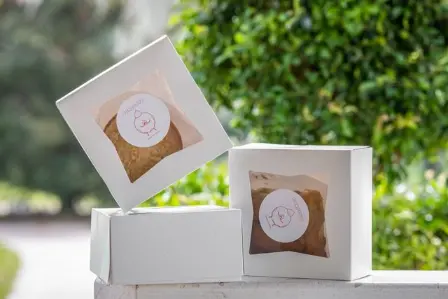
A window can turn an ordinary carton into a small display. Instead of asking customers to imagine what is inside, it lets them see a product’s colour, shape, finish or arrangement before opening the pack. But a clear view is only helpful when the window suits the product and the box still does its job.
Window tuck boxes combine a folding carton with tuck-in flaps and a cut-out viewing area. The opening may be left uncovered or backed with transparent film. The right choice depends on what you sell, what customers need to see, how the product is handled and what the packaging must protect it from.
This guide explains the basics in plain English, compares the main window options, and gives you a practical checklist to use before you request a quote.
Window Tuck Boxes in Numbers: Three Useful Estimates
Percentages can help you compare designs, but it is important to know what each number represents. The figures below are a worked design example, a hypothetical price calculation and a documented research finding, not a promise of the results every business will get.
| What you want to estimate | Example figure | What it means |
|---|---|---|
| Window coverage | 15%, 25% and 35% | Three illustrative front-panel sizes to compare in design mock-ups; these are not universal industry standards. |
| Possible price difference | 15% in the example below | If a standard carton is quoted at £0.40 and a comparable windowed carton at £0.46, the difference is 6p per box, or 15%. These are fictional example prices, not market averages. |
| Sales impact | No universal uplift | One published ready-meal case reported 30% lower sales after switching to transparent packaging. This was one product and should not be treated as a forecast for tuck boxes. |
The point is not to pick a percentage because it looks impressive. Use percentages to compare options, calculate costs from real quotes and understand research in its proper context.
Key Takeaways
- A window is most useful when seeing the real product helps customers understand or choose it.
- An open cut-out and a film-covered window offer different levels of exposure and protection.
- Window size and position must work with the product, folds, glue areas and remaining printed panel.
- Inserts can help hold the product in the right position, but they should solve a real fit or presentation problem.
- There is no universal window-size percentage or standard price uplift that suits every carton; the correct specification depends on the design and production requirements.
- Before approving the box, check the fit, appearance, material suitability, final artwork and any environmental claims.
What Is a Window Tuck Box?
A tuck box is a folding carton that opens and closes using flaps tucked into the body of the box. On a window version, part of a panel is cut away so the customer can see the product through the opening. The box can still carry printed branding and product information around that viewing area.
Some windows are simply cut into the board. Others have a clear film patch attached behind the opening. The film-covered option is often called a window-patched carton. The patch adds another component, so it needs to be considered alongside the board, adhesive, artwork and intended use.
The parts and what they do
| Part | What it does | What to check |
|---|---|---|
| Tuck flap | Opens and closes the carton | It should close cleanly without catching the product or the window area. |
| Window opening | Reveals a chosen part of the contents | It should show something useful while leaving enough supporting board. |
| Clear film, if used | Covers the opening while keeping the product visible | Confirm the film, adhesive and handling conditions suit the product. |
| Printed panel | Carries branding and product information | Keep key text, barcodes and graphics clear of folds and cut lines. |
| Insert, if needed | Holds the contents in a planned position | Make sure the product stays aligned and can still be removed easily. |
When Does a Window Help Sell the Product?
The best reason to add a window is practical: the actual product gives the customer information that a photograph or printed illustration cannot provide as well. A window is less valuable when customers do not need to see the contents or when exposure creates a problem.
Cosmetics and personal care
For selected cosmetics, soaps and personal care accessories, a window can show the product’s colour, shape, finish or arrangement. It may be useful for a set where customers want to see the items included before buying. Think about where the product sits inside the carton; a small item that turns sideways may disappear from the best viewing angle.
Candles, soaps and gift items
The texture of a soap, the colour of a candle or the arrangement of a small gift can be part of its appeal. A window can let the product become part of the design while the remaining board carries the brand and product details. Consider whether the exposed surface will remain clean and presentable during packing, storage and display.
Food and confectionery
A window may help shoppers see the appearance or variety of a food product. However, the construction must be suitable for the way the food is packed. If the food or its inner wrap could contact the board, film or adhesive, ask us to confirm the applicable food-contact requirements. GOV.UK explains that packaging used for food must be suitable for food use and that certain materials require supporting compliance evidence: Food labelling and packaging guidance.
Small accessories and product sets
Stationery, small accessories, craft items and multi-piece kits may benefit from a window when colour, shape or the contents matter to the purchase. For a set, plan the internal arrangement as well as the external opening. If the contents shift during handling, an insert or a different box style may be more suitable.
Open Window or Clear Film: Which Should You Choose?
Both options show the product, but they do not behave in the same way. The right choice depends on the contents, display conditions, hygiene needs and how the carton will be handled.
| Consideration | Open cut-out | Film-covered window |
|---|---|---|
| Visibility | Direct view of the product | View through a transparent patch |
| Exposure | Contents are more open to dust, touch and surrounding conditions | Film covers the opening, though it does not automatically make the pack sealed or airtight |
| Materials | No window film is added | Adds film and adhesive to the carton specification |
| Appearance | Can feel tactile and simple where an open display is appropriate | Gives a more enclosed display and can create a smooth viewing surface |
| Design checks | Consider exposure and whether customers can touch the product | Check clarity, film fit, attachment, glare and how the components are handled at disposal |
Do not assume that a film-covered window makes the entire package tamper-evident, moisture-proof or food-safe. Those properties depend on the full packaging system, its materials and its construction. We can confirm what the selected design does and does not provide.
For a technical explanation of window patching, see Netpak’s guide to window patching for folding-carton packaging. It discusses the opening, transparent film, adhesive areas, structure and production checks that have to work together.
When Might a Window Tuck Box Be the Wrong Choice?
A window should solve a presentation problem, not create a new one. Consider another design if the product needs to be kept away from light, dust or handling, or if the window would take up space needed for instructions, branding or mandatory information.
A window may also be unnecessary when the product is already inside an attractive primary pack, when the outer carton is used mainly for shipping, or when customers get little extra information from seeing the contents. In these cases, a fully enclosed tuck box may provide a simpler way to use the panel space and plan the material specification. You could compare Straight Tuck End Boxes or Reverse Tuck End Boxes as alternatives.
The important question is not whether window packaging looks impressive in a mock-up. It is whether the window makes the product easier to understand without weakening the box, complicating packing or adding a component that provides little value.
Does a Window Increase Sales? What the Research Actually Says
A window can make a product more visible, but visibility alone does not guarantee more sales. The effect depends on the item, the way it looks when exposed, the design around it and what customers expect from the product.
One published study by Vilnai-Yavetz and Koren (2013) reported that a chilled boiled-vegetable ready meal sold 30% less after its packaging changed from an opaque wrapper showing a product image to a transparent cover showing the meal. The study also surveyed 100 supermarket shoppers about the two versions. The authors linked the difference to how customers judged the package’s aesthetics and the quality signalled by the food. This was a specific ready-meal case—not a general rule that windowed cartons reduce sales by 30%. It does show why the product visible through a window must look appealing and suit the brand. Read the study summary.
A later peer-reviewed experiment by Ma, Zhuang and Ma (2020) involved 45 university students evaluating simulated packaging for nuts, preserved fruit and instant cereal. Participants rated purchase intention on a seven-point scale. For nuts, the average rating was 4.82 for transparent packaging, 4.76 for a packaging design showing a product image and 3.93 for a neutral graphic design. However, the transparent option did not consistently outperform the product-image design across the categories tested. Because this was a small laboratory study using selected food products, its ratings are not a forecast of real sales for a UK tuck-box order. Read the full study in Frontiers in Psychology.
What this means for your packaging: don’t assume a window will increase sales by a particular percentage. If the decision matters commercially, compare a few designs with the same product, artwork and price, then use feedback or a real-world test to see which version works better for your audience.
How Big Should the Window Be?
There is no single window size that suits every tuck box. The opening needs to reveal enough of the product to make the view worthwhile, but the panel still needs room for folds, glue areas, printed content and enough board to perform as intended.
Start by deciding what feature the customer should see: the front label, the colour, a specific shape or the arrangement of several items. Then position the product inside the planned box and check how that feature lines up with the opening.
A worked example: comparing 15%, 25% and 35% windows
Imagine a simple front panel that measures 100 mm wide by 150 mm high. Its total face area is 15,000 mm². Before allowing for folds, glue zones or required margins, you could sketch three window concepts and compare the share of the panel each opening covers.
| Concept | Example window dimensions | Window area | Share of the 100 × 150 mm panel |
|---|---|---|---|
| Smaller window | 45 × 50 mm | 2,250 mm² | 15% |
| Medium window | 50 × 75 mm | 3,750 mm² | 25% |
| Larger window | 70 × 75 mm | 5,250 mm² | 35% |
How the percentage is calculated: window area ÷ front-panel area × 100. For the medium example, 3,750 ÷ 15,000 × 100 = 25%.
These three sizes are practical mock-up options, not a published standard or a recommendation that 25% is always best. The actual usable panel may be smaller once folds, scores, glue areas and structural clearances are allowed for. With a custom-shaped cut-out, calculate the true opening area rather than treating the shape’s outer dimensions as the cut-out area. Ask us to check the dieline before you approve the final design.
Why the percentage alone is not enough
You may see general suggestions about limiting the window to a certain share of the panel, but that figure should not be treated as a universal packaging rule. A narrow window near a score line and a large opening in the centre of a wide panel affect a carton differently. Board grade, box dimensions, shape of the cut-out, product weight and handling conditions all matter.
For that reason, this guide does not give an unsupported window-to-panel percentage. Ask us to assess the actual dieline and, where appropriate, provide a prototype or sample. The goal is a window that works with the structure—not simply the largest opening possible.
Keep the window clear of the important details
Avoid placing the opening across a fold, tuck flap, glue area, barcode or key product information. Check the design at the assembled size, because a flat artwork file may not show exactly how the product will sit behind the finished window. Where alignment is important, request a physical mock-up or sample before production approval.
What Materials and Finishes Should You Consider?
The board, printing and any window film should be considered together. The right specification depends on the product, required stiffness, finish, handling and the impression you want the package to create.
Paperboard is commonly used for folding cartons because it can be cut, creased and printed. Kraft-style board may suit a natural, understated look, while a smoother white board may suit detailed graphics or strong colour. Neither appearance alone confirms how strong the finished box will be; the board grade and structure still need to match the product.
If a clear patch is required, ask which film is proposed and whether it is compatible with the window size, adhesive, production process and intended use. For food products, also confirm the relevant food-contact suitability. Avoid choosing a film simply because it looks clear in a sample; the material must be appropriate for the full application.
Printing and finishing options should support the design rather than compete with the product. For example, a carefully positioned logo and a clear product name may be more effective than filling every available panel with graphics. Make sure small text remains readable and keep essential details clear of folds and cut lines. The Preparing Print-Ready Artwork for Your Packaging guide provides further advice on getting packaging artwork ready for review.
Will Window Tuck Boxes Cost More?
A window can add cost compared with an otherwise similar carton because it may require an additional cutting operation, a film patch, adhesive and extra handling or quality checks. The actual difference depends on the specification and production process, so it should be confirmed in a quote rather than assumed to be a fixed percentage.
A simple example of the extra cost
Suppose purely for illustration that a standard carton is quoted at £0.40 per box and an otherwise comparable windowed version is quoted at £0.46 per box. The windowed version costs 6p more per unit. To calculate the increase against the standard carton: £0.06 ÷ £0.40 × 100 = 15%.
| Order quantity | Extra cost per box | Total difference in this example |
|---|---|---|
| 1,000 boxes | £0.06 | £60 |
| 5,000 boxes | £0.06 | £300 |
| 10,000 boxes | £0.06 | £600 |
These prices are invented for demonstrating the calculation; they are not supplier prices or a typical market premium. Your real difference could be lower or higher, and a quotation may include different tooling, setup, film, printing or delivery costs. Ask for a like-for-like quote for both versions before setting your budget.
The main factors to discuss are:
- Window design: size, shape, placement and whether a patch is required.
- Carton dimensions and board: material grade, size and structural requirements.
- Printing and finishing: number of print colours, coatings and special finishes.
- Internal components: whether an insert or divider is required to keep the product in position.
- Order quantity: the quoted unit cost and any setup or tooling charges may vary with the run size and specification.
- Delivery and packing: how the cartons will be packed, shipped and stored.
For a fair comparison, ask suppliers to quote the same dimensions, board, artwork, window type, quantity and delivery requirements. Comparing a basic enclosed carton with a premium windowed carton that uses different board and finishes will not show the cost of the window alone.
A Practical Checklist Before You Place an Order
Before asking for pricing or approving artwork, gather the details our team needs to assess the project:
- Product dimensions, weight and any fragile or protruding features.
- The number of products in each box and how they should sit inside it.
- What customers need to see through the window.
- Whether the window should be open or film-covered.
- Preferred board, print design and finishing requirements.
- Whether an insert is needed to prevent movement or keep the product aligned.
- Where the box will be used: shop display, collection, gift set or outer shipping pack.
- Any relevant food-contact, retailer or product-specific requirements.
- Quantity, delivery destination and target date.
- A final dieline check and, where needed, an assembled sample before approval.
If you are still deciding on the carton style, visit the Window Tuck Boxes page to review this packaging option. Confirm the exact window construction, material and insert requirements with our team before you finalise the specification and quote.
If the product needs internal support, mention your insert requirements in the quotation request so they can be considered with the carton design.
Common Mistakes to Avoid
- Choosing the window before measuring the product. Plan the contents and their position first, then size the opening around what customers need to see.
- Assuming clear film means sealed protection. A window patch covers an opening, but it does not automatically make the carton airtight, moisture-resistant or tamper-evident.
- Leaving too little supporting board. A large or awkwardly positioned cut-out can affect the panel and folding arrangement. Have the complete dieline assessed.
- Forgetting the product can move. If the contents turn or slide, the window may reveal an empty-looking section instead of the feature you intended to show. Consider an insert only when it serves a clear purpose.
- Making broad recycling claims. Paperboard, films, adhesives, coatings and local collection systems can affect end-of-life handling. The UK Competition and Markets Authority’s Green Claims Code guidance explains why environmental claims should be clear, accurate and substantiated.
- Approving from a flat design alone. A printed proof is useful, but it cannot always reveal the assembled fit or the way the product sits behind the opening. Request a sample when the window position or construction makes a meaningful difference.
Sources and Further Reading
- Consumer response to transparent packaging — Vilnai-Yavetz and Koren, “Cutting Through the Clutter: Purchase Intentions as a Function of Packaging Instrumentality, Aesthetics, and Symbolism”. Published in The International Review of Retail, Distribution and Consumer Research in 2013, this study examined a chilled ready-meal product with a transparent cover versus an opaque wrapper showing a product image. The authors reported 30% lower sales for the transparent version and surveyed 100 supermarket shoppers about purchase intentions. The result applies to that specific product and packaging change; it is not a prediction for all window boxes. Read the publication summary.
- Transparent windows and purchase intention — Ma, Zhuang and Ma, “Transparent Windows on Food Packaging Do Not Always Capture Attention and Increase Purchase Intention”. Published in Frontiers in Psychology on 12 November 2020, the study analysed responses from 45 university students viewing simulated packages for nuts, preserved fruit and instant cereal. It used seven-point rating scales and found that clear windows did not consistently outperform product imagery. This supports the article’s caution against promising a universal sales increase. It was a controlled study with a small, specific sample, not a UK market forecast. Read the full open-access study.
- Window patching and carton design — Netpak, “Window patching for folding carton packaging”. This industry guide explains how a transparent film is applied behind a die-cut opening and why the window’s size, position, film, adhesive area, structural design and converting process need to be assessed together. It supports the sections on open versus patched windows, panel strength and pre-production checks. The page does not show a clear publication date, so it is used here for technical background rather than time-sensitive regulation. Read Netpak’s guide.
- Food packaging suitability — GOV.UK, “Food labelling and packaging: Overview”. This official UK guidance says packaging used for food must be suitable for food use and explains that certain materials require written compliance evidence. It supports the advice to confirm food-contact suitability for the specific product and material combination. Requirements can differ across parts of the UK and by material, so check the applicable rules for the product and location. Read the official guidance.
- Environmental marketing claims — Competition and Markets Authority, “Green claims code: making environmental claims”. Published on 20 September 2021, this UK guidance explains principles for making environmental claims that are clear and supported by evidence. It is relevant when deciding whether a package or combination of board, film and adhesive should be described as recyclable or environmentally preferable. It does not certify a particular box as recyclable. Read the Green Claims Code guidance.
- Product options and specification — Custom Tuck Boxes, “Window Tuck Boxes”. The product page covers the window tuck-box category. Use it to review the packaging option, then confirm the specific board, window covering, dimensions, inserts and production requirements with our team before relying on them in a quotation. View Window Tuck Boxes.
Frequently Asked Questions About Window Tuck Boxes
What is a window tuck box?
A window tuck box is a folding carton with tuck-in flaps and a cut-out section that reveals part of the product. The opening may be left uncovered or backed with transparent film, depending on the product and the protection needed.
What products are suitable for window tuck boxes?
They can suit products whose appearance helps customers make a choice, such as selected cosmetics, soaps, candles, confectionery and small gift sets. Suitability depends on the product’s exposure needs, how it sits in the carton and whether the window provides useful information to the buyer.
Should I choose an open window or a film-covered window?
An open window gives a direct view but leaves the contents more exposed to dust and handling. A film-covered window provides a barrier over the opening, but adds film and adhesive to the specification and does not automatically make the package sealed or food-safe. Choose based on the product and its handling conditions.
How big should the window be on a tuck box?
It should be large enough to show the feature a customer needs to see while leaving room for the box’s folds, glue areas, printed information and supporting board. For early mock-ups, you might compare openings covering 15%, 25% and 35% of the usable front panel. These are illustrative test options, not an industry standard; the correct size depends on the carton structure and product.
How much more do window tuck boxes cost?
There is no fixed percentage. For example, if a standard box costs £0.40 and a comparable windowed box costs £0.46, the difference is 6p per unit, or 15%. These are example numbers only. Ask for quotes using the same box size, board, printing, quantity and delivery terms to calculate the actual difference for your order.
Will a window increase my product’s sales?
Not automatically. Research on packaging transparency has found mixed results depending on the product and design, and there is no universal sales-uplift figure that applies to all products. Compare designs with the same product, artwork and price, then use customer feedback or a real-world test to assess which version works better.
Can a window be cut into a custom shape?
A window can often be designed in different shapes, subject to the carton structure and production capabilities. More intricate shapes can affect tooling, the remaining board and the film-patching process, so ask us to assess the design before finalising artwork.
Are window tuck boxes recyclable?
It depends on the full construction and the collection and recycling systems available where the box is used. A paperboard carton with a film window includes multiple components, so do not assume the finished package is recyclable everywhere. Check the material specification and local guidance before printing a recycling claim.
Can window tuck boxes be used for food packaging?
They may be suitable, but the board, film, adhesive and any inner packaging must be appropriate for the particular food and conditions of use. Ask us for the relevant food-contact information and confirm the rules that apply to your product.
What affects the price of custom window tuck boxes?
The price can depend on box size, board grade, window dimensions and shape, whether film is added, print and finishing choices, inserts, quantity and delivery requirements. Request a quote based on the full specification, and compare like-for-like offers rather than assuming a fixed percentage increase for a window.
Where can I order custom window tuck boxes in the UK?
Custom Tuck Boxes can assess the box dimensions, window construction, artwork and intended use together. Visit our dedicated Window Tuck Boxes page. Check the available specification and request a quote to confirm whether the construction you need is feasible.
Make the Window Earn Its Place
A well-designed window should help customers understand the product, not simply create another feature on the carton. It needs to reveal the right detail while leaving the box easy to assemble, suitable for the contents and practical to print and handle.
Before committing to a window tuck box, confirm what the customer needs to see, how the product will be held in place, which materials are suitable and how the finished pack will be used. Then review the actual dimensions and window position with our team.
Explore Window Tuck Boxes and request a quotation to discuss your product dimensions, artwork and window requirements. Ask our team to confirm the available construction and final specification before approving production.